“Empowering students to learn ‘how to learn’ and to engage them in continuous self improvement is the challenge for educators” but what about the enhancement of educators themselves? (CLA 4). As with learning, ways of educating have changed dramatically. Whether at the beginning, or near end of their career, a teacher can always work towards improving their practice. One of the best ways to do so is by reaching out to the librarian within their school. Resulting in the enrichment of their learning, both on a personal and professional level. The following two scenarios are meant to serve as indicators of the varying degrees with which educators use reference resources within their teaching practice. The examination of each scenario provides readers with practical ways of increasing this use using the Concerns-Based-Adoption-Model (CBAM).
Scenario #1: The Novice Teacher
Mr. Jones has just recently graduated from the Secondary Teacher Education Program at the University of British Columbia. He applied for a temporary job posting as a grade nine Social Studies teacher and was the successful candidate. Being new to the school and district, Mr. Jones is excited but somewhat overwhelmed. His lack of experience, paired with his unfamiliarity with the staff, have made it hard for him to seek help. The students are currently working on an ancient civilizations project which requires them to evaluate and make use of academic sources to support their research. Knowing he is new to the school; the teacher librarian (TL) has made a point of speaking to him about his upcoming project. She has suggested he bring the students to the library for a brief lesson on finding information and citing sources. Mr. Jones is happy to have the TL’s support and agrees to bring his class in.
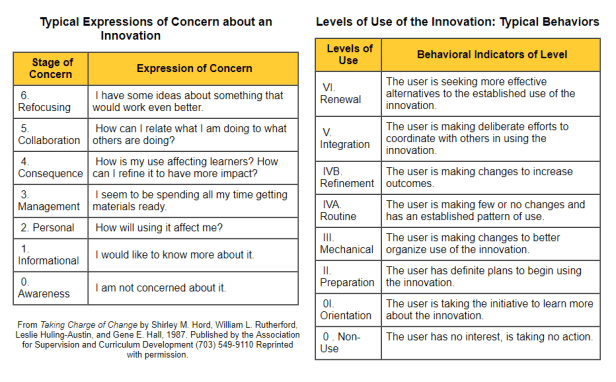
At this point in time Mr. Jones could be categorized in the “Non-use or Orientation” level of use according to his “behavioural indicators” (CBAM). By “taking the initiative to learn more about the innovation” the goal would be to move Mr. Jones into the “Preparation” level of use (CBAM). While a visit to the library is a great starting point for a new teacher, it is important for the TL and classroom teacher to meet ahead of time to go over the criteria for the project and make any necessary adjustments to ensure it meets curricular and individual needs. Adaptions can then be laid out, even before the students visit the library. Mr. Jones is a novice teacher, as such, he has had minimal integration of reference resources within his practice. The TL can take this opportunity to increase his level of reference resources and assist him in supporting his students’ learning.
The Concerns-Based- Adoption Model (CBAM) views “change as a process [where] individuals progress through various stages regarding their emotions and capabilities relating to the innovation” (CBAM). Being a new teacher, Mr. Jones is likely feeling overwhelmed. According to the predicted CBAM results, “with strong orientation, training, mentoring, AND other such program support, beginning employees can move beyond the consequence level to the collaborative level in about three years” (CBAM). While it may take some time, it is possible for Mr. Jones to effectively integrate reference resources into his practice. This change will not only strengthen his pedagogical practice but work to extend the learning of his students. Since he is new to the profession, I would recommend the teacher librarian sit down with him to develop “innovation-related policies” and planning.
“The CBAM diagnostic dimensions provide evidence of the current extent and quality of implementation that leaders can use to drive decisions and actions” (Sedl.org, 2020). TLs can use the Innovation Configuration process, for example, to determine how a novice teacher like Mr. Jones can incorporate a new program into his practice and how it should look. By working together to create an Innovation Configuration Map, Mr. Jones and the TL will have clear expectations to help guide them through the process. Having this document on hand will allow Mr. Jones “to focus on one component at a time” (Sedl.org, 2020). By breaking up his learning, Mr. Jones will likely feel more at ease. In addition to this, the “IC Map serve[s] as [a] useful reflective tool for collaborative professional learning teams in discussing the progress of a program” (Sedl.org, 2020). Revisions can be made and put into practice to better suit teacher needs which is great for someone like Mr. Jones, who is at the start of his career.
This focus on collaboration between the classroom teacher and the TL goes hand in hand with the Canadian Library Association’s (CLA) assertion that the “teacher librarian collaborates with other teachers to plan lessons and help [them] to develop best practices and strategies” (CLA 6). With expert instruction from both Mr. Jones, and the TL, these students can start to work with “the best technologies and resource collections available” to strengthen their research on ancient civilizations (CLA 7).
The ways in which this TL can help Mr. Jones and his class:
- Improve the use of technology
- Encourage the effective use of resources (in various forms) to support research/learning and teaching
- Improve student engagement and an interest in developing from a professional standpoint (Mr. Jones)
- Preparing students and Mr. Jones to develop information literacy skills
- Support the growth of both students and their teacher, Mr. Jones
Scenario #2: The Veteran
Mrs. Brown is a veteran teacher who has established herself within her school. Having grown up in the community she is well known and respected. As an experienced educator she often relies on traditional ways of teaching that are dated and unengaging for her students. When it comes to incorporating new programs and/or technologies into her practice Mrs. Brown is somewhat reluctant. She seems to think that her traditional ways of doing things have been successful up until this point, so “Why change them now?”. Her students are currently working on a five-paragraph essay to showcase their writing skills. After numerous attempts to connect with Mrs. Brown the TL has decided to try a new approach. She has offered to co-plan and co-teach a unit on internet safety to Mrs. Brown’s students. With the changes in technology and the vast number of students using their devices in her class, Mrs. Brown agrees to the TL’s invitation. She hopes that doing so will at least allow students to use their devices for good.
Based on her behavioral indicators, Mrs. Brown could be placed in the “Routine level of use”. Her practice appears to have become routine, leaving her fixed in the same level of use. Doing so not only prevents her from developing professionally, but also assumes that change is not needed for her students. There could be nothing farther from the truth. By acknowledging that times have changed and so too, should her practice, Mrs. Brown is making the appropriate steps towards change.
The goal would be to move Mrs. Brown from the “routine category to one of refinement or even integration” (CBAM). Despite being on the recipient end of rejection, it is imperative the TL understand that “resistance to change is a natural phenomenon” leaving some individuals, in this case Mrs. Brown, feeling uneasy or even threatened (CBAM). By making multiple attempts, she was eventually successful in ensuring Mrs. Brown continues to develop her practice. Simply allowing the TL to co-plan and co-teach a unit has proven to be a big step for Mrs. Brown. Fortunately, cooperatively developing this unit will encourage Mrs. Brown to evolve her practice. The TL will no doubt, help to incorporate new technology and relevant resources to foster learning for both Mrs. Brown and her students.
The ways in which this TL can help Mrs. Brown and her class:
- Improve the use of technology
- Encourage the effective use of resources (in various forms) to support research/learning and teaching
- Improve student engagement and an interest in developing from a professional standpoint (Mrs. Brown)
- Preparing students and Mrs. Brown to develop information literacy skills
- Support the growth of both students and their teacher, Mrs. Brown

Conclusion:
Both teachers demonstrate the importance of recognizing that change is “a highly personal experience,” unique to the individual hoping to implement it (CBAM). While Mr. Jones focuses on his awareness and personal plan of action, Mrs. Brown may question what aspects are working and which ones could be re-evaluated. As they move through “the Stages of Concern’s definition of human learning and development” both teachers will be on various levels. Mr. Jones could be seen as working within the lower three stages, while Mrs. Brown would likely be placed on the middle stages. Regardless of where a teacher stands, it is important to keep moving forward in order to achieve success. By encouraging teachers to frequent the library and/or make effective use of its resources, the TL can ensure that he or she promotes inquiry-based learning to prepare students for the future.
Additional Reading:
Here is a link to a blog post from a retired middle school librarian outlining the ways in which school librarians can help classroom teachers today.
“12 Ways a School Librarian Can Help Teachers” – https://2peasandadog.com/2018/07/12-ways-a-school-librarian-can-help-teachers.html
Works Cited:
Canadian Library Association. Leading Learning: Standards of Practice for School Library Learning Commons in Canada. Canadian Library Association, 2014.
Kris, et al. “12 Ways a School Librarian Can Help Teachers.” 2 Peas and a Dog [online] Available at: https://2peasandadog.com/2018/07/12-ways-a-school-librarian-can-help-teachers.html Accessed 19 Feb. 2020.
Sedl.org. (2020). Concerns-Based Adoption Model (CBAM). [online] Available at: http://www.sedl.org/cbam/ Accessed 23 Feb. 2020.
The Concerns-Based Adoption Model (CBAM): A Model for Change in Individuals. [online] Available at:https://s3.wp.wsu.edu/uploads/sites/731/2015/07/CBAM-explanation.pdf Accessed 21 Feb. 2020.
 Sarah's Blog
Hi Sarah, I like the CBAM graphics that you found, I wish I had found that for mine so that others that are not familiar with the model could more easily follow the explanations in regards to the example teachers. The lesson that you propose for “the veteran” is a good idea because I feel like those teachers are the most challenging to get the “buy in”.
LikeLike